Rupture of Quadriceps Tendon Results in $2,200,000 Pain and Suffering Jury Verdict; Reduced on Appeal to $1,600,000

The quadriceps tendon is located at the top of the patella and is attached to the quadriceps muscle. It is critical for ambulation because it allows the knee to move from a position of extension (straight) to a position of flexion (bent). When it ruptures, the patella loses its anchoring support in the thigh and one cannot stand up as the knee will buckle and give away.

Here, you can see the importance the quadriceps tendon and muscle:

Recognizing how painful and debilitating a quadriceps tendon rupture can be, an appeals court has now upheld almost 75% of a Bronx County jury’s $2,200,000 pain and suffering verdict for a 45 year old woman who tripped and fell over a subway station’s broken step.

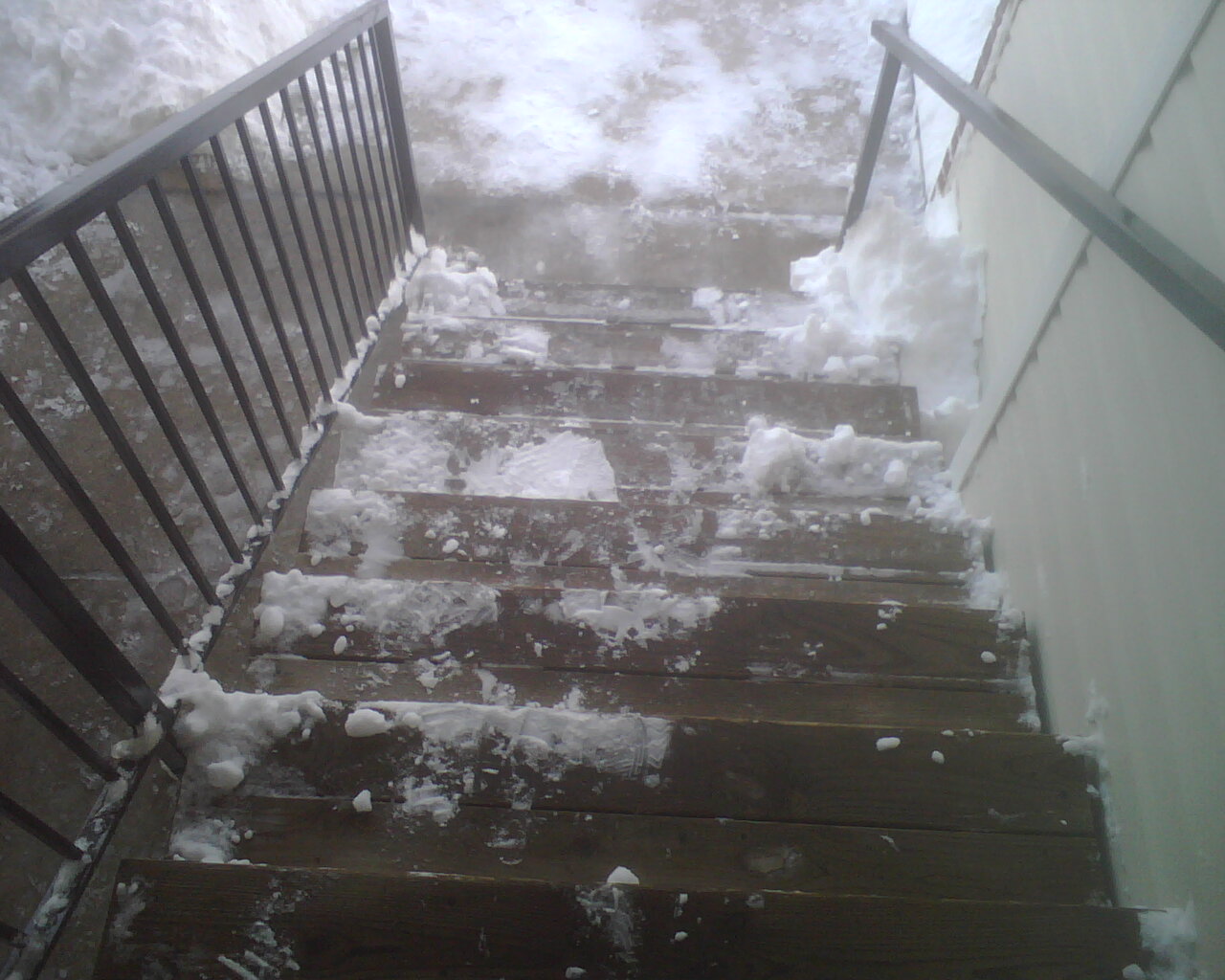
On April 15, 2003, Juanita Clotter was returning home after a long day as a factory worker when she entered the subway station at 149th Street and the Grand Concourse in the Bronx (right by the courts and Yankee Stadium). She fell down the stairs when she tripped and later sued the New York City Transit Authority (the city agency that manages the subway and its station areas) claiming that she fell because the city  negligently maintained the area and created a dangerous condition in that a significant chunk of a step was worn and broken away.

Unable to move from the bottom of the stairway, Ms. Clotter was taken by ambulance to a nearby hospital where she was diagnosed with a ruptured quadriceps tendon. The tendon in her right leg had literally torn away from her patella (the kneecap) and pulled away with it a small piece of the bone.

This is what a quadriceps tendon rupture looks like:

Surgery was required in which an eight inch incision was made so a hole could be drilled through the bone and fiber wire run through the kneecap and secured. At trial five years later, Ms. Clotter and her doctors testified that she was unable to walk without the use of crutches or a cane, could not return to work, had a seven inch disfiguring scar in front of her leg and had atrophy and swelling

After the jury returned its $2,200,000 pain and suffering verdict, the defendants appealed claiming it was excessive because plaintiff had only minimal treatment after the surgery and three months of physical therapy, she could not quantify her pain and made no efforts to improve her condition on her own. Plaintiff countered that her complaints of pain and disability were substantiated by her orthopedic surgeon, Jerry Lubliner, M.D., who testified in detail as to the severity of the trauma and the permanency of Ms. Clotter’s injuries.

Last week, the appellate court pretty much agreed with the plaintiff in Clotter v. New York City Transit Authority. While finding that $2,200,000 was excessive, the judges stated that $1,600,000 ($800,000 past - 5 years, $800,000 future - 16 years) would be reasonable. That’s a reduction of little more than 25%.

The only case cited by the court in its discussion of the proper amount for pain and suffering is Orellano v. 29 East 37th Street Realty Corp. (2004); however, that case is not very relevant. It dealt with a 47 year old man who sustained a comminuted fracture of his tibia and fibula, underwent several surgical procedures during a two month hospital stay and was left with a permanent, partial disability. On appeal, his $5,500,000 pain and suffering verdict was deemed excessive and the sum of $750,000 ($375,000 past, $375,000 future) was found to be appropriate. It’s not at all clear why the judges in Clotter (dealing with a ruptured quadriceps tendon) thought that the Orellano decision (dealing with a tibia-fibula fracture) is pertinent or offers any guidance.

There were several recent cases that did deal with quadriceps tendon ruptures that were not but could and should have been discussed in Clotter not only by the judges but also by the lawyers. Here they are:

  • Verzivolli v. State of New York (2002) - $675,000 pain and suffering award by trial judge ($125,000 past – 5 years, $500,000 future – 33 years) for a 39 year old roofer whose quadriceps muscle was torn by a power saw. He underwent arthroscopic surgery to remove loose cartilage in his knee. He was left with a limp and needed a cane to walk.
  • Scott v. New York City Transit Authority (2004) [court order silent on injury details - affirmation of counsel, here, provides details] - $1,200,000 jury verdict for pain and suffering ($600,000 past – 4 years, $600,000 future – 18 years) for a 60 year old unemployed man who tripped and fell sustaining a rupture of his quadriceps tendon requiring surgery and leaving him with a limp and the need to wear a leg brace. The plaintiff had difficult liability issues on appeal and this case settled for less than the verdict amount while the defendant's appeal was pending.
  • Gainey v. City of New York (2000) - $600,000 jury verdict affirmed on appeal for pain and suffering ($300,000 past, $300,000 future) for a 34 year old unemployed man who tripped and fell on a city park’s pathway and suffered a torn quadriceps tendon requiring surgery and leaving him in a permanently and progressively debilitated physical condition.

In view of the prior cases that dealt squarely with quadriceps tendon injuries, it appears that the plaintiff in Clotter has broken though to new heights in obtaining appellate court approval of a pain and suffering award of $1,600,000.

Inside Information:

  • The original decision in Clotter that was posted on the court’s web site clearly stated at the outset that there was to be a reduction of the verdict from $2,200,000 to $1,600,000; however, the last sentence in the decision (before the concurring opinion) stated that “$500,000” each for pain and suffering would be an appropriate award. This caused no small amount of confusion that day and calls to the court revealed that there was a typographical error and the corrected decision now has $800,000 each in the body of the decision.
  • While the concurring opinion of Justice McGuire states that he feels that the reduction of the jury verdict to $1,600,000 did not go far enough, he did not state what he concluded would be the proper increased reduction. Insiders tell me that his figure was $1,000,000 and that’s why there was a reference to $500,000 each (past and future) in the body of the opinion – there had been a back and forth between the majority and this justice that mistakenly made its way into the original decision.


Medical Malpractice Lawsuit Saga in NY: After 13 Years, Doctors Lose Two Trials, Fail to Enforce a Favorable Settlement Agreement and Must Pay $1,405,000

It’s not an uncommon situation in the ever-uncertain world of jury deliberations in personal injury and medical malpractice cases in New York and nationwide. After years of litigation, months of trial preparation and weeks of trial testimony, the jury is deliberating and each side again assesses its strengths and weaknesses. A settlement is finally discussed and appears to have been reached. The end? Usually, but not in one medical malpractice case that started in 1996 with surgery in Brooklyn and ended this week with an amazing appellate court decision.

On June 5, 1996, a 32 year old college math professor underwent a lengthy surgery to repair chronic instability in his left knee. Immediately following surgery, he felt severe pain in his right leg which was swollen and deformed. Turns out, he had deep venous thrombosis (DVT) in three veins in his right calf and was ultimately diagnosed with tibial and peroneal nerve damage and RSD resulting in permanent intense, burning pain in his right leg requiring lifelong narcotic pain medication.

The left leg (the one operated on) healed well; however, as to his right leg (the one not operated on and with respect to which he never before had any problems) Mahmoud Diarassouba sued his orthopedic surgeon and his two anesthesiologists claiming that their failure to reposition his right leg during the lengthy surgery was a departure from good and accepted medical practice that caused his right leg injuries.

These are the types of support stirrups used in knee surgeries:

Prof. Diarassouba won his case in 2003 when the jury found the doctors liable for $1,500,000 in pain and suffering damages ($500,000 past – 7 years, $1,000,000 future – 37 years). Here is a copy of the verdict sheet with the jury’s findings.

The defendants appealed the verdict against them on several grounds but mainly because certain evidence was improperly heard by the jury and other evidence was improperly held from them. The appellate court agreed, issuing a decision setting aside the verdict and directing a new trial.

The new trial was held in 2007. When the jury was deliberating a verdict, the parties appeared to have reached a settlement. Plaintiff’s attorney told the defendants’ attorney that plaintiff would accept defendants’ $150,000 offer and plaintiff’s attorney then told the court clerk who found and told the judge. At that time, though, the judge just received a note from the jury advising that they had reached a verdict!

Plaintiff’s attorney asked the judge to memorialize the settlement by putting it on the record – i.e., by stating the details in open court, having them transcribed by the court reporter and having defense counsel and the plaintiff himself state that they are in accord with and agree to the terms. The judge refused and told the plaintiff’s attorney that he would first bring in the jury and have its verdict read after which, the judge said, the parties would be free to do what they agreed to.

The jury was "out" - still in the jury room - when plaintiff's attorney advised the judge of a settlement:

The jury came in. The verdict was announced: the doctors were again found liable for pain and suffering damages, this time in the sum of $1,450,000 ($800,000 past – 11 ½ years, $650,000 future – 30 years).

This was a stunning development. Clearly, plaintiff had anticipated a defense verdict and had been eager to settle for a mere $150,000. Just as clearly, the jury found the defendants at fault and they assessed damages at 10 times the purported settlement figure. So: had the case already been settled for $150,000 or would the $1,450,000 verdict stand? Those were the questions in the second appeal in this case, a decision on which was issued this week holding that there was no legally enforceable settlement and the verdict stands.

At first glance, it looks like plaintiff was seeking to wiggle out of a binding agreement that he wished he hadn’t made since the verdict was so much more favorable. On close examination, though, the court’s decision makes sense and is fair. Before the verdict was announced, defense counsel had not acknowledged that a settlement had been reached. My reading is that the defendants were trying to have it both ways – hoping the verdict would exonerate them but if it didn’t and the verdict was more than $150,000 then defense counsel could claim (as he ultimately did) that a settlement had been reached for only $150,000.

Settlements during trial are common but to make them binding in the absence of a signed written agreement the law (CPLR 2104) requires the attorneys to place the settlement agreement on the record – typically meaning that they announce the details of the settlement in open court, before the judge, with the court reporter transcribing the statements and the settling parties themselves stating that they understand the terms of the settlement and agree to them. None of that was done in this case, in part because the judge wanted the verdict announced first and in part because defense counsel did not state that he or his clients acknowledged and agreed to the $150,000 proposal (that is, until after the verdict was read).

Inside Information:

  • In the first trial, liability was apportioned 60% to the orthopedic surgeon and 20% each to the anesthesiologists but in the second trial the surgeon’s share was 30% and the shares of the other two were 35% each.
  • Before the second trial, the surgeon settled with the plaintiff for $390,000.
  • Since the surgeon was 30% at fault in the second trial, plaintiff’s total verdict of $1,450,000 was reduced by 30% as against the other two defendants and the plaintiff is entitled to only $1,015,000 from them. Since plaintiff already has $390,000 from the surgeon, his total recovery here is $1,405,000.


$3,000,000 Pain and Suffering Verdict Sustained on Appeal for Ten Year Old New York Girl Injured in Horrifying Subway Accident

November 4, 2001 began as a great day for ten year old Leonari Jones. She was an active, playful, happy kid who had a sleepover party and was on the subway returning home to the Bronx with her  friends and babysitter. When the train pulled in to her stop at 174th Street, though, Leonari’s life took a tragic turn.

As she exited the subway car, Leonari placed her left foot on the platform but her right foot became caught between the doors. She tried to dislodge her leg but couldn’t and the train pulled out so she started to hop on her left leg to keep up with the increasing speed of the moving train.

This shows similar city subway doors but Leonari wasn't going in, she was trying to get out:

What followed was terrifying and gruesome.  I will spare you all of the details. The train sped up to 30 miles per hour and dragged Leonari about 300 feet before it stopped and she fell 30 feet to a secondary platform. During those terrifying moments, Leonari’s skin was ripped off and her leg was broken as her hands, stomach and body were dragged, burned and scraped along the subway platform. She was rushed to the hospital where she was diagnosed with:

  • Right leg Salter II fracture of the distal tibia with the fracture line extending through the tibia and into the growth plate
  • Second degree wounds and abrasions akin to burn injuries to approximately 10% of her body surface area

This poor 10 year old then underwent a nine day hospitalization in which her right leg was placed in a cast from her torso to her ankle and, every four to six hours, she underwent excruciatingly painful tissue debridement to treat her burns. To the extent she could sleep at all, Leonari’s sleep was interrupted constantly with nightmares and screaming. At trial, she claimed she suffered significant post-traumatic stress symptoms.

Leonari started using crutches after two months (due to hand bandages she could not use them before) and finally after five months she began to walk unassisted (though with a permanent limp).

Trial on damages only resulted in a Bronx County jury verdict on August 14, 2006 in the sum of $3,000,000 for pain and suffering ($1,500,000 past – 5 years, $1,500,000 future – 63 years). In a decision released two days ago, the appellate court in Jones v. New York City Transit Authority affirmed the entire award and declared that the amount did not deviate materially from what would be reasonable compensation (the standard for review under New York’s CPLR 5501).

This is a stunning decision, especially in view of several facts not mentioned:

  • Plaintiff never underwent any surgery for either her leg fracture or her burns
  • Plaintiff didn’t undergo any psychological treatment until January 2005 when she first did so at the urging of her lawyers

We know that New York juries can and do render amazingly high (and low) pain and suffering verdicts from time to time; however, that’s why CPLR 5501 was enacted and that’s when appellate courts get into the action and modify the awards up or down as they see fit. Why in this case, though, did the appellate court allow $3,000,000 in pain and suffering damages to stand without any modification downward in view of what appears to be a non-catastrophic injury case? This is neither a case dealing with a paralyzed person, nor one on lifetime pain medication, nor one with an inability to walk at all.

Digging into all of the facts and reviewing the parties’ briefs on appeal, we have uncovered the following additional facts not mentioned in the court’s decision:

  1. Battle of medical experts: Plaintiff’s orthopedic expert was world-renowned David P. Roye, M.D. He’s a pediatric orthopedist who operates on kids 200 times a year. The defense orthopedist (who performs 70% of his work in the litigation field) conceded on the stand that Dr. Roye has superior knowledge in this field.
  2.  Plaintiff’s broken leg was two centimeters shorter than her other leg due to the accident, and Dr. Roye, a published expert on leg length discrepancy, testified that this was quite significant and disabling, resulted in pelvic obliquity (a crooked pelvis) and will require surgery to repair. 
  3. Plaintiff was previously very active in multiple sporting activities, can no longer engage in any of them and now walks with a limp.
  4. Plaintiff’s right knee dislocated many times since the accident and she will require at least one knee surgery in the future.
  5. Plaintiff produced a plastic surgery expert who testified that her scars all over her abdomen, underneath her breasts and on both legs are permanent. Defendant failed to produce an expert to rebut this testimony and the jury was able to evaluate the scars in person at trial.
  6. Both parties presented expert testimony as to plaintiff’s psychological injuries. Plaintiff’s expert testified that she has a textbook case of post-traumatic stress syndrome with significant symptoms including nightmares, persistent fears, sleep problems, difficulty relating to people, concentration problems and flashbacks; while the defense expert disagreed on the basis of a 20 minute examination without having reviewed the medical records.
  7. Plaintiff’s mother testified that as a social worker with clinical training, she sought faith based counseling before turning to psychotherapy for her daughter. Clearly, this blunted the defense argument about the lack of “formal” counseling until her lawyers suggested it.

The defense conceded that this was a horrible incident and that the plaintiff deserved compensation for her pain and suffering; however, they argued that $3,000,000 was unreasonably high. In what may have been a tactical mistake, the defense suggested on appeal that they only challenged the future pain and suffering award of $1,500,000 and that the past pain and suffering sum (also $1,500,000) was reasonable. Then, they suggested that the court view the future pain and suffering verdict as having been rendered by the jury in three equal parts for orthopedic, dermatological and psychological injuries (i.e., $500,000 for each category). Finally, the defense asked the court to reduce the future pain and suffering award from $1,500,000 to $550,000 ($350,000 orthopedic, $100,000 each for dermatological and psychological).

The court must have considered the $350,000 concession by the defense for future orthopedic pain and suffering against the $500,000 (hypothetical) award to be a minor variance and not worth reviewing and then it simply declined to modify the (hypothetical) awards of $500,000 for future dermatological pain and suffering (against a $100,000 concession and 63 years of scars and disfigurement) and $500,000 for future psychological  pain and suffering (against a concession of $100,000 and 63 years of post-traumatic stress symptoms).

The only two cases cited by the court in its decision were Lopez v. Gomez (2003) and Carl v. Daniels (2000), each of which we discussed previously, here.  Each dealt with a youngster with a femur fracture ($1,500,000 affirmed for past pain and suffering in Lopez; $4,800,000 affirmed for past and future pain and suffering in Carl) and each seems relevant, though not dispositive.

Jones  v. New York City Transit Authority involved a unique combination of injuries with reciprocal exacerbating effects. It may, therefore, turn out to be a case that’s not oft-cited but it’s clearly one that grabbed the attention of the jury and so impressed the jury, the trial judge and the appellate court that $3,000,000 was awarded and affirmed for pain and suffering in a non-catastrophic injury case. It deserves to be studied.


Update on $4,500,000 Jury Verdict for Cop Who Shot Himself in Knee

We wrote about Detective Anderson Alexander back in December, here. He's the former former New York City policeman who accidentally shot himself in the knee when a defective chair broke at his precinct house.

Don't sit in a chair like this:

And definitely don't sit in that chair with a gun like this in your belt:

Detective Alexander sued the city claiming that it was responsible for the broken chair (and that he was not responsible for the gun's discharge). Alexander won and the jury awarded him $4,500,000.

We predicted that the city would appeal and that's in the works now. The trial judge issued a short decision a few months after the verdict in which he stated that the damages award was reasonable. Just this week, the appellate court issued a brief order extending the city's time to file its appellate briefs until November 13, 2009.

In the meantime, here is how the $4,500,000 damages verdict broke down:

  • $1,500,000 for pain and suffering ($500,000 past - 7 years, $1,000,000 future - 30 years)
  • $1,700,000 for future loss of earnings
  • $1,060,000 for future loss of pension
  • $250,000 for future medical expenses
  • $38,00 for loss of annuity

Mr. Alexander took his verdict, was given a line of duty retirement by the police department and then he got out of town. He moved to South Carolina to work as a deputy sheriff supervising a courthouse metal detector. While we focus on these pages on pain and suffering damages analysis, one wonders whether it's appropriate under the facts of this case for Alexander to recover $1,700,000 for future lost earnings (plus more than $1,000,000 for lost pension and annuity) in view of his claim that he was in constant pain and so disabled he could not resume work.

As to pain and suffering, if the liability verdict is upheld on appeal, the judges will address the reasonableness of the damages verdict for Alexander's knee injury. Here are the cases that the court will likely look to for guidance in determining if $1,500,000 was a reasonable sum for Alexander's pain and suffering:

  • Urbina v. 26 Court Street Associates LLC : $2,200,000 ($700,000 past - 7 years, $1,500,000 future - 41 years) for a 31 year old man who fell and sustained an intra-articular patella fracture and a torn meniscus requiring three surgeries leaving him with a permanent limp [Urbina case discussed here]
  • Smith v. Manhattan & Bronx Surface Transit Operating Authority : $900,000 ($100,000 past - 6 years, $800,000 future) for a 43 year old woman who was injured boarding a bus and sustained torn menisci, a torn ligament and cartilage and a permanent osteochondral defect, requiring arthroscopic surgery with another to follow and a knee replacement possible [Smith case discussed here]
  • Nassour v. City of New York : $1,500,000 ($500,000 past - 8 years, $1,000,000 future - 27 years) for a 42 year old man who fell and sustained torn meniscal cartilage, underwent arthroscopic surgery and a high tibial osteotomy and was left with permanent reflex sympathetic dystrophy (RSD)

We will report when the Alexander case is resolved and, if the liability verdict is upheld, we will see how the appellate court assesses pain and suffering damages and whether and to what extent the judges consider the cases discussed here.

New York Appeals Court Inadequately Explains its Order Deducting $455,000 from Pain and Suffering Verdict for Firefighter with Wrist, Shoulder and Knee Injuries

On December 22, 1999, Lieutenant Nocenzu Cusumano, a New York City firefighter, reported to work at the city's recently renovated Staten Island training center. He slipped on stairway debris and fell 16 feet down to a concrete floor. He reached out for a handrail or banister but none was there as the renovation was illegal and violated the building code.

Like these stairs under construction, there was no handrail or banister:

Here are the injuries Lt. Cusumano sustained:

  • crushed left hand and wrist with fractures of his hamate, capitate and lunate bones requiring reconstructive surgery with pins and wires
  • left shoulder impingement requiring two surgeries (known as acromioplasty) to remove bone and scar tissue
  • exacerbation of previously torn meniscus in his knee now requiring surgical repair

In the ensuing lawsuit, Cusumano v. City of New York, a Queens County jury awarded plaintiff pain and suffering damages in the sum of $1,700,000 ($1,200,000 past, $500,000 future). The past award was for the seven years from the date of the accident to the date of the verdict. The future award was based on plaintiff's life expectancy of 15 more years.

The defendant appealed, claiming that $1,700,000 was excessive and the appellate court agreed as to the past pain and suffering verdict. It held that $1,200,000 was too high and reduced it by $455,000 to $755,000. The $500,00 verdict for future pain and suffering was affirmed.

So, on what basis did the appeals court conclude that $455,000 should be deducted from the jury verdict for past pain and suffering? We have previously noted that appeals courts often provide no basis at all in their decisions reducing personal injury jury verdicts (for example, here and here). In this case, though, the judges purport to provide some basis for their decision.

The decision states that  " ... upon consideration of the nature and extent of the injuries sustained by the plaintiff [the court did recite the specific injuries in its decision], the jury's finding that the plaintiff sustained damages in the sum of $1,200,000 for past pain and suffering deviated materially from what would be reasonable compensation to the extent indicated herein [i.e., the past pain and suffering verdict was $455,000 too high]." That's the usual standard statutory language of CPLR 5501 inserted into almost every appeals court decision wherein damages are reduced (or increased). That provides no guidance or justification.

The judges then go on to cite six prior cases as support for their decision. Let's take a look at those cases and see if they do.

  1. Deshommes v. Hussain - 40 year old taxi driver in car accident sustained a herniated disc (no surgery). The jury verdict of $1,200,000 ($300,000 past, $900,000 future) was reduced on appeal to $700,000 ($200,000 past, $500,000 future).
  2. Pitera v. Winzer - a 37 year old man in a car accident sustained a torn meniscus requiring surgery (as well as bulging cervical discs and a herniated lumbar disc none of which required surgery). The jury's $1,100,000 verdict ($450,000 past, $650,000 future) was reduced on appeal to $550,000 ($200,000 past, $350,000 future).
  3. Jansen v. Raimondo & Son Constr. Corp. - a 36 year old firefighter fell injuring both shoulders requiring surgery on each. The jury verdict of $730,000 for future pain and suffering was reduced to $400,000. The $350,000 for past pain and suffering was affirmed and thus the total affirmed was $750,000.
  4. Purcell v. Axelsen - a motorcyclist sustained fractures of her pelvis (no surgery),  wrist (surgery) and a lumbar vertebrae (no surgery). The jury verdict of a mere $10,000 (past only) was increased on appeal to $250,000 ($130,000 past, $120,000 future). There were significant credibility issues at trial regarding both plaintiff and her treating doctor that resulted in the low jury verdict.
  5. Frascarelli v. Port Auth. of N.Y. & N.J. - a 35 year old who was assaulted sustained a torn meniscus requiring arthroscopic surgery. Plaintiff was out of work for only six weeks and required no more surgery.  The jury verdict of $700,000 ($300,000 past, $400,000 future) was reduced on appeal to $450,000 ($225,000 past, $225,000 future).
  6. Perez v. Farrell Lines - a 58 year old fell and sustained a traumatic brain injury and a shoulder injury. The jury verdict of $650,000 ($400,000 past, $250,000 future) was affirmed.

We have reviewed the six cited cases in detail and urge readers to do so as well. In many respects, they deal with injuries different from those ruled on in Cusumano v. City of New York. We do not believe they support the decision to deduct nearly half a million dollars from Lt. Cusumano.  The jury that heard this case listened to each of the witnesses (including of course the plaintiff and his treating doctor), assessed the credibility of each and every witness and deliberated carefully among themselves before rendering their verdict. That's how our legal system works in New York injury cases.

An appeals court may disturb the jury's verdict only when it finds the amount deviates materially from reasonable compensation (CPLR 5501). To make that finding, the appeals court must have a basis. It cannot pull numbers out of thin air. It should explain its reasoning. Merely citing cases, some of which involve similar injuries and some of which involve injuries not at all relevant is not right. It is neither instructive to the bar and the public nor is it even academically proper.

More and instructive reasoning must be given so that the bar and the public can be guided by the upper and lower limits appeals courts are likely to set in New York injury cases. When that's done, there will be a reduction in trials as more cases are settled because everyone knows the limits.

New Judicial Decisions in Knee Injury Cases Set Pain and Suffering Awards between $250,000 and $900,000

Judicial decisions in several recent cases demonstrate the wide range of possible outcomes for pain and suffering awards in knee injury cases.

We last visited this topic when discussing the New York City police officer who shot himself in the knee and convinced a jury not only that the city was at fault but also that he should recover  $4,500,000. That case will not be over until an appeals court rules. We expect a significant reduction in the pain and suffering award, if not an outright dismissal on liability grounds. We are following.

A very significant knee injury award for pain and suffering was largely upheld on appeal early last year in Urbina v. 26 Court Street Associates LLC . There, a 31 year old laborer fell off a scaffold and suffered both an intra-articular patella fracture and a torn meniscus. After three surgeries, he still needed at least two total knee replacements. Mr. Urbina was left with permanent pain, a limp and severe disabilities. The jury's $3,500,000 pain and suffering verdict ($1,000,000 past, $2,500,000 future) was reduced on appeal to $2,200,000 ($700,000 past, $1,500,000 future).

In the meantime, a Nassau County judge in a trip and fall case has issued a post-trial decision in Linzer v. Town of Oyster Bay reducing a $950,000 pain and suffering verdict ($450,00 past, $500,000 future) to $375,000 ($150,000 past, $225,000 future). In that case, a 45 year old doctor sustained a comminuted intra-articular fracture of her right leg's patella (the kneecap) requiring surgery to insert two metal screws to hold two large bony fragments together and sewing a third piece, all so that the patella would be held together.

Here's what that knee looked like after surgery:


After trial, the defense made a motion to set aside the $950,000 verdict as against the weight of the evidence. Justice F. Dana Winslow issued a decision on the post-trial motion that addressed all of the injuries and discussed the case precedent cited by each side.

In reducing the jury verdict, the judge was influenced by the facts that Dr. Linzer:

  • did not suffer from any post surgery complications
  • was on pain medication for only one month
  • had no limp
  • returned to work three months after the surgery

In a recent appellate court decision, the court in Smith v. Manhattan & Bronx Surface Transit Operating Authority upheld a Bronx county jury's $900,000 verdict for pain and suffering in favor of a 43 year old woman who injured her knee when boarding a bus whose driver closed the door on her causing her knee to twist, and then he drove away and dragged her about eight feet.

Ms. Smith sustained these injuries:

  1. tears of her medial and lateral menisci          
  2. torn cruciate ligament
  3. torn cartilage
  4. permanent osteochondral defect


She underwent arthroscopic surgery but by the time of trial six years later, plaintiff had developed significant scar tissue, had substantial range of motion deficits and suffered from continuing pain, buckling and weakness all of which her doctor said were permanent injuries that would require more surgery including a knee replacement.

Lastly, we mention Gaston v. City of New York, in which a Bronx county jury awarded the grand total of $5,000 for past pain and suffering and nothing at all for future pain and suffering for a woman who suffered a torn meniscus that necessitated surgical repair. The appeals court found those awards to be unreasonable and ordered an increase to $250,000 ($200,000 past, $50,000 future).

The cases discussed here make plain that the range of damage verdicts in knee injury cases is quite wide - not only for the juries ($5,000 in the Gaston case to $3,500,000 in the Urbina case) but also for the appeals courts ($250,000 in Gaston to $2,200,000 in Urbina).  As we see in Gaston, when the jury awards a figure the appeals court finds is too low, then there will be an increase but not to the highest figure the court would have sustained. Instead, as in Gaston,  the courts will increase an unreasonably low award to the lowest amount that would have been upheld as not unreasonably low. And when an award is found to be unreasonably high, the appeals court will simply order a reduction to a figure that is the highest it would have sustained.

If the jury comes in too high or too low well then watch out because the appellate court will not make it all just perfect. The appellate courts will merely order an increase or a decrease into a range they deem reasonable. And in knee injury cases, the range of sustainable pain and suffering awards is quite wide.

Unusual Sports Related Injury Case Plaintiffs Failing to Win Damages

In several unusual sports related cases around the country recently, injured plaintiffs have failed to win any damages. If we count "slam dancing" as a sport then the score is no wins, two losses and two ties (to be broken by trials down the road).

Loss #1: In Fry v. Jolly Roger Rides, Inc. a Maryland jury returned a verdict for the defense finding that an amusement park was not negligent when an errant basketball struck a woman in the head. Chrisitne Fry had been walking at an amusement park pier when a basketball used in a long range basketball shot game deflected off the game's apparatus and struck her. She claimed that a year and a half later she underwent neck surgery because the force of the ball aggravated a pre-existing cervical spine injury.

The defendant had sought a dismissal before trial claiming that there was no way it could foresee such an accident. The motion was denied. No matter. The jury heard testimony that there had been no one injured from the game in five years and that the incident was so unexpected the defendant should not be liable for having failed to foresee it. And so the jury dismissed the case.

  • As our friends at Torts Prof Blog suggested, Ms. Fry's husband probably helped the defense with his testimony that he thought the odds of this accident were "one in a million."

Loss #2: In Schoneboom v. B.B. King Blues Club, a New York judge dismissed without a trial the case of a Manhattan concert goer who sustained a torn anterior cruciate ligament in his knee requiring surgery.

David Schoneboom admitted that he knew there was wild, violent "slam dancing" (also known as moshing) all around the heavy metal band concert.

He still went right up to the front near the stage, next to some of the wildest activity. Low and behold, he got bumped by an unknown person and then he sued the club. The judge found that he had assumed the risk of such an occurrence and injury because he knew that the aggressive moshing was taking place and still deliberately placed himself in proximity to it.

Tie #1: In Sweeney v. Bettendorf, an eight year old girl in the stands at a professional minor league baseball game in Iowa was injured when a player lost control of his bat which traveled 120 feet and struck her in the head.

Tara Sweeney was on a field trip organized by her city parks department. Her injury case against the city was initially tossed out by the trial judge but an appeals court has now ruled (5-2) that the case may proceed to trial because the city had a duty to protect the child's safety at the ballpark and that a jury could find that parks employees put her in an unreasonably hazardous location to watch the game.

Tie #2: In Allred v. Capital Area Soccer League, Inc., the North Carolina Court of Appels overturned a lower court's pre-trial dismissal of an injury case brought against a soccer league by a spectator at a game who was struck in the head by a soccer ball before the game even started. Teresa Alford had been in the stands behind one of the goals while the teams were warming up and many balls were being shot by the players towards the goal.

One shot sailed over the goal and hit Teresa casuing severe head injuries.

In discussing the assumption of the risk doctrine, the court noted that the case is at an early stage and the defense has not shown that Ms. Allred's knowledge of soccer was such that she should have known of the inherent risks of being hit by an errant ball. So the judges ruled that this case may proceed. For now.

  • My prediction: defense verdict at trial.

These assumption of the risk cases will continue to be brought and they will always be controversial.

There appear to be three schools of thought on these cases:

  1. Many who would like to see all of the plaintiffs in cases like the ones discussed here completely barred from the courthouse or, if allowed to trial and they lose, forced to pay the winner's legal fees.
  2. Others would would like to see a remedy for every person injured, no matter the fault, no matter the social and economic consequences.
  3. Judges who will continue to play a large part in the outcome of each individual case as well as on the impact their rulings have on society at large.

And we will continue to report on these cases and engage in discussions about them.

$4.5 Million Jury Verdict for Cop Shot in Knee

Ouch! Bullet in the knee. But in Alexander v. City of New York a cop shot himself!

When Detective Anderson Alexander leaned back in a chair at his Brooklyn, New York precinct house, it didn't hold his weight and he stumbled out of the defective chair and his gun accidentally discharged. He sued the city for the defective chair and won when the jury recently returned a $4.5 Million verdict in his favor.

Since the knee injury left him disabled, he was entitled to a pension from the NYC Police Department worth 3/4 of his last active duty salary. So with little to claim in lost earnings why did the jury award him millions? For his pain and suffering, that's why:

  • 2 surgeries and many months of physical therapy
  • at least one knee replacement surgery required in the future and here's what that knee will look like after the knee replacement surgery:


  • only 49 years old with almost 40 more years life expectancy - all with pain, suffering and disabilities in his knee and leg
  • must use cane to walk stairs
  • cannot walk more than a few blocks
  • cannot bend down

As with many very large personal injury verdicts, the question remains: will the verdict stand up? Will he be paid? The city has already said it will appeal. That could take about two years. Would the amount awarded in the jury verdict stand up on appeal? Probably not if it's all for pain and suffering.

While each bodily injury case is different, even unique,  when analyzing verdicts for the same body part - here, the knee - there is never certain guidance or precedent from one case's jury verdict to the next. But there is some guidance ..... so let's see what an important appellate court said recently regarding knee injury pain and suffering award amounts.

The most recent significant knee injury appellate pain and suffering decision is Urbina v. 26 Court Associates, LLC, a case that began in New York Supreme Court and made its way up to the appellate court for that area, the Appellate Division First Department. On December 6, 2007, the appellate court ruled on the propriety of a jury's awards for a 31 year old electrician's assistant who fell from a scaffold and sustained an intra-articular fracture of his patella (kneecap) and a tear of his knee's lateral meniscus. After two surgeries and evidence that he would need a third, the jury determined that Mr. Urbina's past pain and suffering for his knee injury merited $1,000,000 and for his future pain and suffering $2,500,000. The appeals court disagreed and held that the past pain and suffering award should be reduced to $700,000 and the future pain and suffering award should be reduced to $1,500,000. Thus, the court found proper a total of $2,200,000.

So what does all this mean for Detective Alexander? Nothing if the city wins its appeal on liability - the city will argue that it was not liable at all, especially in the absence of the actual chair for the jury to see at trial (a fact the detective says is the city's own fault).

If liability is affirmed, the question remains: is $4,500,000 too much? Will the appeals court let it stand? Probably not, in view of the Urbina case. Don't get me wrong - I wouldn't take $4,500,000 in exchange for a bullet shot into my knee, two surgeries, more to come, use of a cane, etc. No way. But this is not the standard the appeals court will apply. It will analyze these injuries and treatment and compare them with what's happened in other similar cases and what amounts have withstood appellate review in the past.

The appeals court hearing Detective Alexander's case will apply the following test, as set forth in CPLR 5501(c), New York's statute setting forth the standard regarding appellate claims that a jury award is excessive or inadequate: did the amount awarded by the jury deviate materially from what would be reasonable compensation?

We will follow this case as more details come out and as and if the appeals process continues.

For other cases involving jury verdicts and settlements in New York for pain and suffering in knee cases, see: The Hochfeler Report on Knee Injuries